
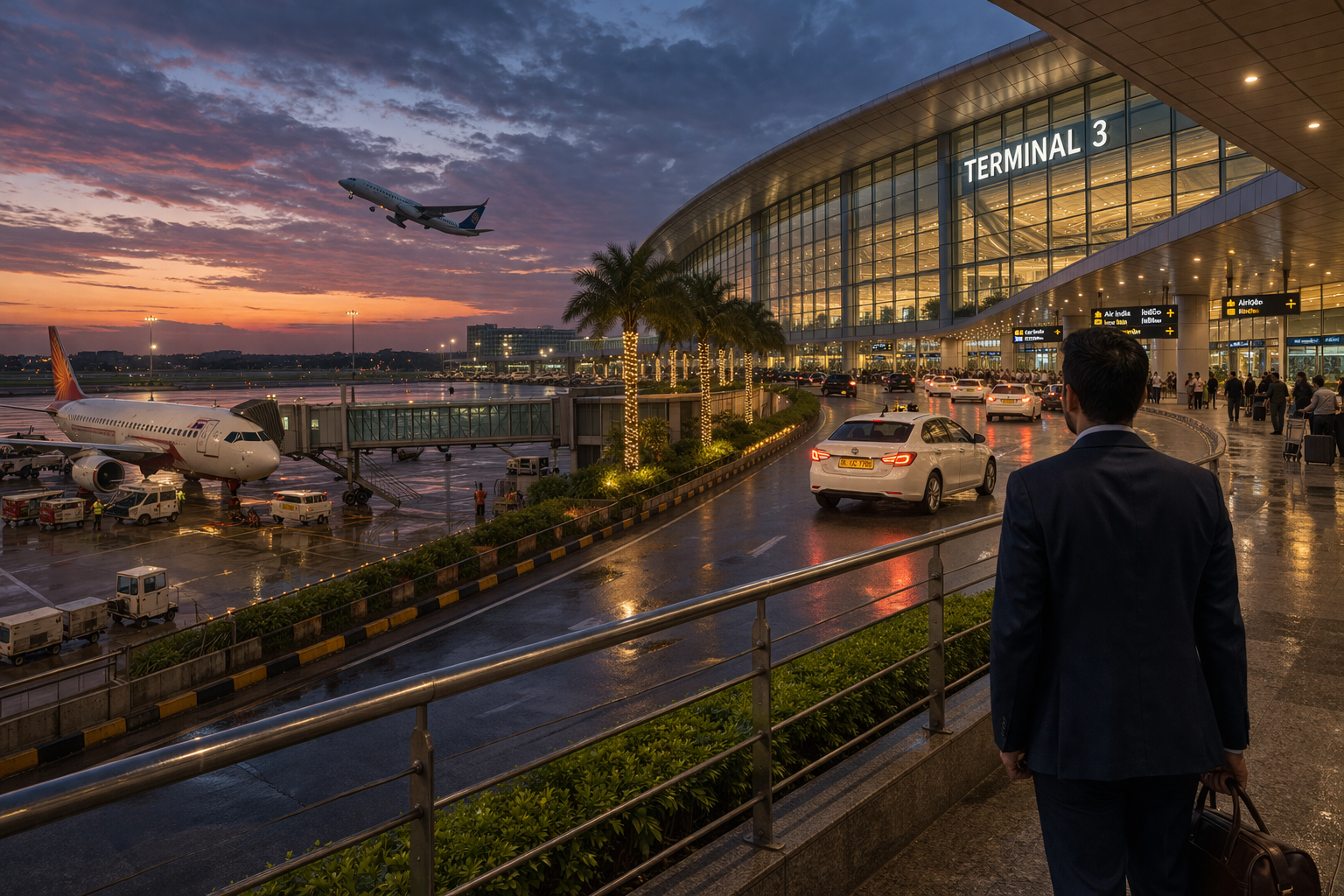
4 Star Hotels in Aerocity Delhi: How to Choose the Right One for Your Flight Time, Stay Length, and Where Your Meetings Actually Are
Aerocity was purpose-built. Every hotel in this district opened after 2010, sits within 1.5 km of T3, and was designed for a single traveller profile: someone who needs to be near an airport. That clarity is also the problem. Four-star hotels in Aerocity Delhi are marketed uniformly as convenient, premium, and business-ready, but which one suits a one-night transit differs entirely from what works for a three-day corporate visit with meetings across South Delhi. Most people booking these hotels make their choice on star rating and distance to T3 alone, ignoring two variables that determine whether the stay actually delivers: their meeting locations and their departure time. This guide gives you the framework to make that decision correctly, and explains when Aerocity is not the right answer at all [source].
What Aerocity Is and What Most Travellers Get Wrong About It
Aerocity is not a neighbourhood in the traditional Delhi sense. It is a planned hospitality district developed under a master plan by Delhi International Airport Limited (DIAL) specifically to serve Terminal 3 of Indira Gandhi International Airport. The entire zone, formally called the 'Hospitality District' in DIAL's development framework, was built on greenfield land adjacent to the airport boundary. Every hotel in it is relatively new construction, purpose-designed for transit and business travel, and located along a single access road running through the district.
This matters practically because it makes Aerocity unlike any other hotel zone in Delhi. In areas like Connaught Place, Saket, or Vasant Kunj, hotels developed organically within existing neighbourhoods. They have street-level restaurant access, walkable local markets, and neighbourhood character. Aerocity's hospitality zone trades all of that for one thing: guaranteed proximity to T3. There are no external restaurants within walking distance of most properties, no local market, and no after-dinner walk. The hotel restaurant is the dinner option, at hotel prices.
The misconception that causes the most booking errors: many travellers treat 'near IGI Airport' and 'in Aerocity' as synonymous. They are not. Properties in Mahipalpur (some 8-15 km from T3 depending on route), Dwarka Sector 8, and Palam frequently advertise as airport hotels. Some are legitimate 20-minute transfers; others are 45 minutes in peak traffic. True Aerocity properties sit inside the DIAL-managed zone; they are either a complimentary shuttle ride or a 5-minute cab from T3's departure forecourt. Verifying a hotel's exact pin location before booking, not its neighbourhood label, is the first rule of Aerocity selection.
The Decision Most Business Travellers Get Wrong When Booking 4 Star Hotels in Aerocity
The most common mistake among corporate guests booking airport hotels in Aerocity, Delhi, is optimising for airport proximity when they should be optimising for the meeting location.
Consider this scenario: a consultant from Bengaluru arrives at T3 on a Monday evening for two days of back-to-back client meetings in Connaught Place and Nehru Place. They book a 4-star Aerocity hotel because the airport proximity feels efficient. What they experience is 35-45 minutes of cab travel from the hotel to each meeting location every morning, the same in reverse each evening, a hotel environment with no after-dinner walk and a single restaurant they eat at twice a day and, on balance, a stay that costs ₹3,000-₹5,000 more per night than an equivalent quality hotel in Vasant Kunj or Saket that would have put them 20 minutes closer to their actual meetings.
The Airport Express Line is the other misunderstood factor. Aerocity Metro Station connects to New Delhi Railway Station in 18 minutes genuinely useful for one specific corridor. But the Airport Express runs as a separate system from the main Delhi Metro network. Reaching South Delhi, Defence Colony, or Greater Kailash from Aerocity Metro requires boarding the Airport Express, transferring at New Delhi station onto the Yellow Line, and often a further transfer a total journey of 55-75 minutes versus a 30-40 minute direct cab.
How to Evaluate and Choose Among 4-Star Aerocity Hotels: A Framework
Start with five questions before applying any price filter. First: What is your departure time? An early-morning flight genuinely changes the value calculation. Second: how many nights are you staying? Aerocity economics work best for one night; they depreciate with each additional night. Third: Where are your meetings? This determines whether metro or cab access to the city matters. Fourth: Are you coming as a group requiring MICE facilities? Aerocity's hotels were designed with this in mind. Fifth: What is your loyalty programme alignment? Most major chains operating in Aerocity are international brands, and loyalty accrual matters on frequent-traveller stays.
Running those five filters before looking at price typically eliminates two or three of the available options immediately and clarifies whether an Aerocity hotel or a near-Aerocity alternative is the right starting point.
|
Option |
Best For |
Key Tradeoff |
Price Range / Night |
|
4-star hotel in Aerocity proper |
One-night transit, very early departures, MICE groups requiring on-site conference facilities |
Premium price, no walkable dining, poor connectivity to South/Central Delhi beyond one metro line |
₹6,000–₹12,000 |
|
4-star hotel near Aerocity (Mahipalpur / Dwarka) |
Budget-sensitive travellers needing airport proximity |
Variable quality; 20-45 min from T3 depending on traffic — verify pin location before booking |
₹2,500–₹6,000 |
|
5-star hotel in Aerocity |
Premium corporate entertaining, luxury transit stays, high-profile MICE events |
Significant per-night premium for marginal room quality increase over 4-star; same connectivity limitations |
₹12,000–₹30,000+ |
|
4/5-star in Vasant Kunj (e.g. The Grand New Delhi) |
Multi-night stays, South Delhi meetings, business + leisure, families wanting neighbourhood dining |
15-25 min to T3 (vs 5-8 min); no airport shuttle — offset by better city metro access and lower rates |
₹5,000–₹12,000 |
|
Budget hotel near IGI Airport |
Very short layovers, cost-sensitive single-night stays |
Inconsistent quality, unreliable shuttle, limited business amenities, no loyalty accrual |
₹1,200–₹3,500 |
What Changes Depending on Who You Are and Why You're There
Flight departure time is the single variable that changes the Aerocity calculation most sharply. A 5:30 am departure from T3 represents a genuine case for proximity. The cab from Vasant Kunj at 3 am is manageable, but the risk of traffic or a no-show driver when missing a flight is the consequence that carries real weight. For departures after 9 am, the difference in transfer time between an Aerocity hotel and a Vasant Kunj property shrinks to 10-15 minutes, a gap that rarely justifies the per-night premium in Aerocity rates.
For corporate groups requiring MICE facilities, Aerocity's hospitality zone was explicitly designed for this segment. The district's hotels have dedicated conference infrastructure built into their original design, multiple breakout rooms, high-capacity banquet halls, in-house audio-visual teams, and catering at scale. Hotels with equivalent conference capacity outside the Aerocity zone are fewer and typically require more advance planning to confirm availability.
For families with children, the dependency on hotel restaurants for all meals and the absence of walkable local life make Aerocity a functional but sterile environment for anything beyond an overnight transit. Families spending two or more nights in Delhi before a flight are better served by a hotel in a residential South Delhi neighbourhood that offers walkable restaurant access and proximity to attractions, with a planned cab or metro transfer to T3 on departure day.
International arrivals with long immigration queues also change the calculation differently. By the time a T3 international passenger clears customs and collects baggage, the time-saving of an Aerocity hotel over Vasant Kunj has already largely been consumed. The real advantage of Aerocity for international arrivals is the simplicity of the route, not the time saved.
Common Mistakes When Booking Airport Hotels in Aerocity Delhi
Booking without verifying the shuttle schedule against your departure time. Most 4-star hotels in Aerocity offer complimentary transfer to T3, but scheduled shuttles typically run every 30-60 minutes. A 5 am departure requires a 3:30-4 am shuttle. Confirming that this service exists and is operational at your specific time before booking is non-negotiable. Calling the hotel directly is more reliable than checking the website, where shuttle schedules are rarely updated in real time.
Trusting 'near Aerocity' labelling without a PIN check. Properties in Mahipalpur and Dwarka Sector 8 range from genuine 20-minute airport transfers to 45-minute journeys in morning traffic. The difference between a 20-minute and 45-minute transfer on the morning of an early flight is the difference between making it comfortably and risking the boarding cut-off. Paste the hotel's address into Google Maps and check the driving time to T3, specifically not walking time, not average, but the realistic traffic-adjusted estimate for your departure time.
Underestimating the food cost differential. Aerocity's hospitality district has extremely limited external dining. Budget at least 25-35% more for daily food costs versus a hotel in a neighbourhood with street-level restaurant access. A ₹400 dinner at a South Delhi dhaba becomes a ₹1,800 hotel restaurant set meal in Aerocity a real daily cost difference across a three-day stay that partly offsets the perceived premium of a more expensive neighbourhood hotel elsewhere.
Assuming 4-star uniformly means business-ready. MICE and conference facilities vary significantly within Aerocity's 4-star bracket. Some properties have full conference centres with dedicated AV teams; others have a converted breakfast room with a projector and an HDMI cable. For a corporate event with external clients, confirming specific facility specifications, seating capacity in different layouts, AV equipment, catering, and dedicated event staff with the hotel directly prevents costly surprises on the day.
The Real Cost of the Aerocity Proximity Premium — What Nobody Quantifies
This is the calculation that does not appear in any standard hotel comparison: the actual financial cost of the airport proximity advantage in Aerocity, expressed per minute of transfer time saved.
In normal daytime traffic conditions, a 4-star hotel in Aerocity proper is 3-8 minutes from T3's departure forecourt by complimentary shuttle or cab. A well-located 4-star hotel in Vasant Kunj, The Grand New Delhi, for example, on Nelson Mandela Marg, is 15-25 minutes from T3 on the same route via NH-48. The real transfer time premium for Aerocity is therefore 10-18 minutes in normal conditions.
The rate differential between comparable 4-star products in Aerocity and Vasant Kunj for the same period typically runs ₹2,000-₹5,000 per night, varying by season and demand. A traveller staying two nights and paying ₹3,500 more per night in Aerocity is spending ₹7,000 extra to save approximately 10-18 minutes on each of two airport transfers a cost of roughly ₹200-₹350 per minute of transit time saved. That is rational for a 4 am departure, where anxiety about missing the flight is real. It is rarely rational for an 8 am departure on a clear morning.
The Vasant Kunj alternative also offers specific advantages that Aerocity cannot: Yellow Line metro access from Chattarpur Station (direct to Central Delhi without a transfer), walkable restaurants in the surrounding area, proximity to Qutub Minar and the Mehrauli corridor for leisure hours, and a quieter residential environment with more dining variety. These are not trivial differences for a two or three-night stay. For single-night transit: Aerocity wins. For anything longer, the arithmetic deserves closer examination.
The Honest Answer: When Aerocity Is the Wrong Choice
The tradeoff that every Aerocity guide omits: the hospitality district's uniformity is both its strength and its limitation. Every 4-star hotel in the zone is modern, functional, and proximity-efficient. None of them is particularly memorable, and in a market where most brands operate on centralised procurement, the difference between a ₹6,500 and a ₹9,000 room in Aerocity is often minor: a slightly larger room, a club lounge with complimentary breakfast, and marginally better linen.
The genuine insight for frequent travellers: Aerocity is the right call when the airport is the point. When Delhi is the point, when you have two or three days of meetings, relationships to build, and evenings worth spending staying in Aerocity makes you a person who lives between hotel rooms and cabs. Staying in a well-located South Delhi hotel with direct metro access, street-level restaurants, and a neighbourhood to walk in makes you someone who was actually in Delhi.
Business hotels in Aerocity Delhi are infrastructure, not hospitality. Excellent infrastructure for a specific use case. For everything else, the 15-minute drive to the airport is not the hardship it is marketed to be.
Plan Your Delhi Airport Stay
If your Delhi trip involves more than one night, or if your meetings are in South or Central Delhi rather than Gurgaon, The Grand New Delhi offers a considered alternative to Aerocity, with premium quality, 15-25 minutes from T3, and direct metro access to the city without the airport-line transfer.
Frequently Asked Questions About 4 Star Hotels in Aerocity, Delhi
1. How much do 4-star hotels in Aerocity Delhi cost per night?
4-star hotel rates in Aerocity typically range from ₹6,000 to ₹12,000 per night for standard rooms, varying by brand, season, and booking lead time. Rates increase 30-60% during peak domestic travel seasons (Diwali, Holi, summer holidays) and around major MICE events in Delhi. Booking 10-14 days in advance on weekdays consistently produces the most competitive rates. Loyalty programme members should compare direct hotel rates against OTA prices — direct bookings frequently include breakfast or early check-in perks not available through aggregators.
2. 4-star hotels in Aerocity vs 4-star hotels in Vasant Kunj — which is better value?
For single-night transit stays and very early-morning departures, Aerocity's proximity makes it the right choice despite the rate premium. For two or more nights with meetings in Central or South Delhi, a 4-star hotel in Vasant Kunj or Saket offers equivalent quality at ₹2,000-₹5,000 less per night, with better metro connectivity, walkable dining options, and only 10-18 minutes more transfer time to T3. The value calculation shifts firmly in favour of South Delhi hotels as stay length increases beyond one night.
3. Is it safe to book a hotel near Aerocity that's not inside the DIAL hospitality zone?
Safe to book, but due diligence is essential. Properties outside the DIAL-managed Aerocity zone vary significantly in quality and actual distance from T3 — some are 20-minute transfers, others are 45 minutes in traffic. Before confirming any 'near Aerocity' hotel, verify the property's exact Google Maps pin distance from T3, check the shuttle schedule against your departure time, and read reviews dated within the last 90 days specifically mentioning the airport transfer experience.
4. Do all 4-star hotels in Aerocity offer airport shuttle service?
Most 4-star properties in Aerocity proper offer complimentary shuttle transfers to and from T3, but schedules typically run every 30-60 minutes rather than on-demand. For early-morning departures (before 6 am), always call the hotel directly to confirm the shuttle operates at your specific time — website information is often not updated. Some hotels offer 24-hour on-demand transfers at an additional charge. Hotels outside the Aerocity zone have less consistent shuttle arrangements and cab transfer costs should be factored into the total stay cost.
5. What MICE facilities do business hotels in Aerocity Delhi typically offer?
Aerocity's hospitality district was explicitly designed for MICE travel, and most 4-star properties have dedicated conference infrastructure: meeting rooms accommodating 10-200 delegates in multiple layout configurations, breakout rooms, in-house AV teams, and integrated catering. The range of quality within the 4-star bracket is significant — some properties have full conference centres; others have converted dining rooms. For events above 50 delegates, always request a site visit and confirm specific AV equipment, room acoustics, and dedicated event coordinator availability before signing a contract.
6. Are 4-star hotels in Aerocity good value for family stays?
Functionally adequate but not ideal for families spending more than one night in Delhi. Aerocity's hospitality district has no walkable restaurants, local markets, or attractions outside the hotel compounds — all meals happen at hotel prices, which adds ₹3,000-₹6,000 to a family's daily costs compared to a neighbourhood hotel with external dining access. Families with a T3 departure after a multi-day Delhi visit are better served by a South Delhi hotel during their stay with a planned transfer to the airport on departure day.
7. Does it matter which terminal I'm departing from when choosing an Aerocity hotel?
Significantly, if you're on a domestic flight from Terminal 1 or Terminal 2. Aerocity hotels are optimised for T3 — the international and major domestic terminal. T1 (primarily IndiGo and SpiceJet domestic) is located approximately 7-10 km from Aerocity in the opposite direction, and the transfer adds 15-25 minutes to your journey time. Travellers with T1 departures are sometimes better served by accommodation closer to that terminal. Always confirm your specific terminal when evaluating hotel proximity.
8. How does The Grand New Delhi compare to Aerocity 4-star hotels for airport stays?
The Grand New Delhi in Vasant Kunj sits 15-25 minutes from T3 by road via NH-48 — approximately 10-18 minutes more than an Aerocity hotel in normal conditions. The hotel offers 4/5-star room quality, multi-cuisine in-house dining, a full-service spa, and banquet and conference facilities at rates that are typically ₹2,000-₹5,000 per night lower than comparable Aerocity properties during the same period. For guests with Delhi meetings, the Yellow Line metro from Chattarpur Station provides direct connectivity to Central Delhi without an airport line transfer. Contact the reservations team to confirm current rates and corporate arrangements.