
Hotels in Central Delhi: How to Choose the Right Area Before You Book
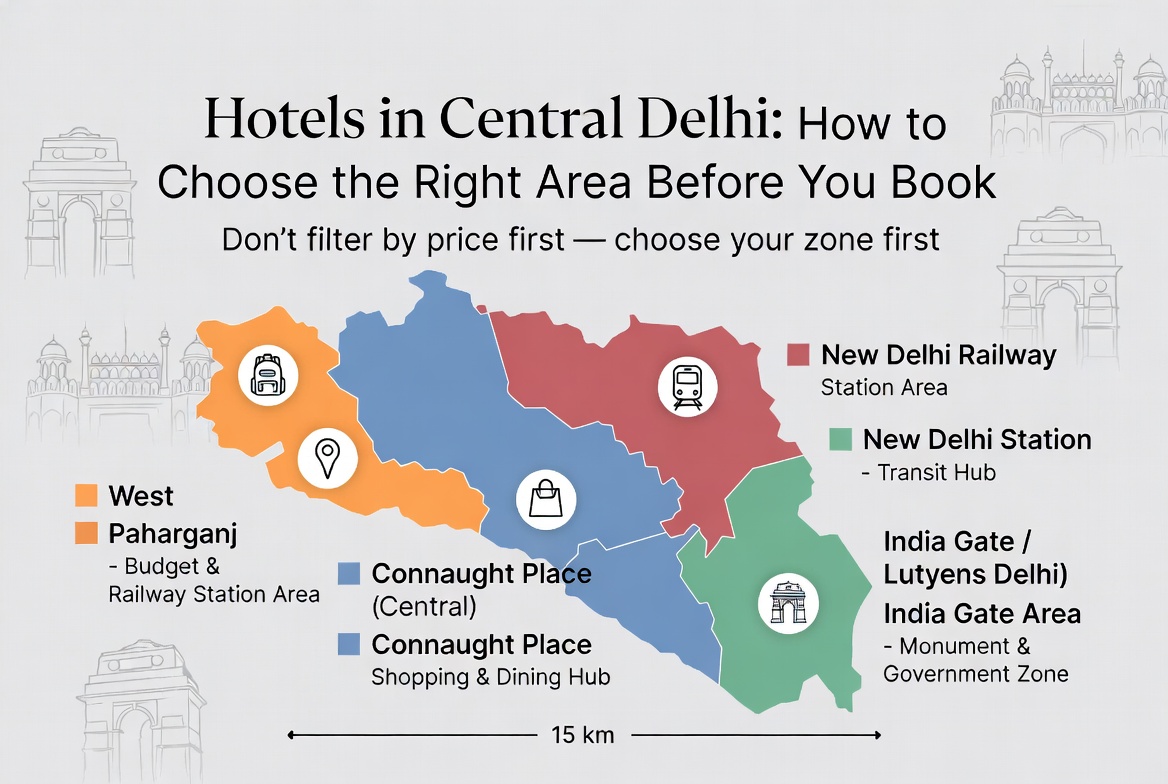
Most travellers searching for hotels in central Delhi make the same mistake: they filter by price and star rating before they've decided which part of 'central' they actually need to be in. Central Delhi spans roughly 15 kilometres from Paharganj in the west to the India Gate hexagon in the east, and the difference between staying near Connaught Place versus near New Delhi Railway Station isn't cosmetic; it changes your daily commute, your noise level, your restaurant options, and in some seasons, your room rate by 40%.
This guide doesn't rank hotels by décor. It maps the four main central Delhi zones to the traveller types they actually suit, then identifies where the value sits in each. By the end, you'll know exactly which area to filter for before you open a single OTA tab.
What 'Central Delhi' Actually Means and Why It Matters Before You Search
The phrase 'central Delhi' appears on every hotel listing site but is defined by none of them. In practical terms, it refers to the area bounded by the Ring Road in the west and north, the Yamuna in the east, and the ceremonial axis from Rashtrapati Bhavan down Rajpath to India Gate in the south. Within that boundary sit four meaningfully different accommodation zones.
Connaught Place (CP) is the commercial and social hub, circular, walkable, and the closest thing Delhi has to a city centre. Paharganj, directly behind New Delhi Railway Station, is the traditional backpacker corridor: dense, chaotic, cheap, and either charming or exhausting depending on your tolerance. Karol Bagh, to the northwest, is a mid-market neighbourhood popular with domestic business travellers and families who want space, local restaurants, and reasonable rates without the budget hostel atmosphere of Paharganj. The India Gate–Lutyens zone is where Delhi's five-star properties cluster, priced for expense accounts and high-end leisure.
Conflating these four zones is what produces bad hotel decisions. A traveller who books a Paharganj property because it's labelled 'central Delhi' and then discovers they have a morning meeting at Aerocity 20 kilometres southwest has not saved money. They've created a daily commute in one of the world's most congested cities [source].
The Mistake Most Visitors Make When Choosing a Central Delhi Hotel
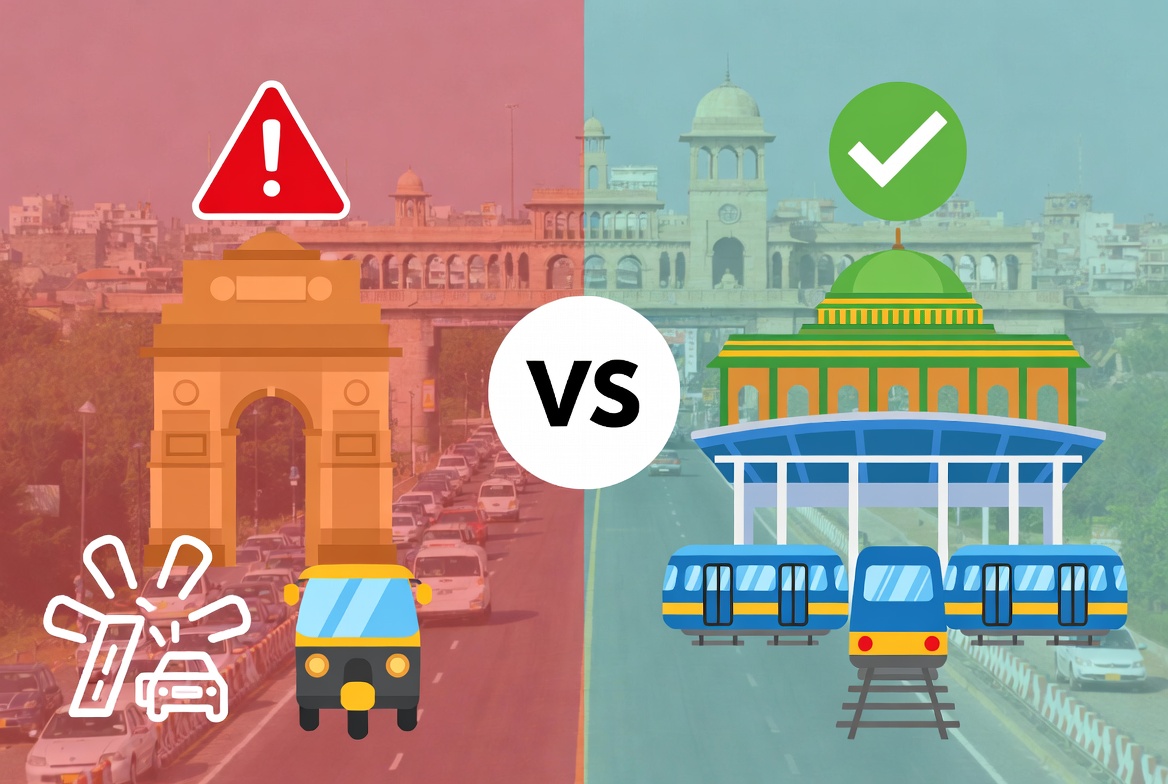
The most common error is optimising for proximity to the wrong landmark. Visitors see 'walking distance from India Gate' and assume this makes a hotel well-connected. India Gate is a monument. It has no metro station. Hotels clustered around it require an auto-rickshaw or cab to reach any metro line, which in peak traffic can take 25–35 minutes. For a leisure visitor, this is inconvenient. For a business traveller with a morning flight, it's a genuine problem.
Metro connectivity is the variable that most hotel comparison sites don't surface. The Yellow Line (connecting Samaypur Badli to HUDA City Centre) runs through Rajiv Chowk, the CP metro station, and is the spine of central Delhi's transport. A hotel within 600 metres of Rajiv Chowk gives you direct, air-conditioned access to Hazrat Nizamuddin (for trains south), Chandni Chowk (for Old Delhi), and, via an interchange at New Delhi station, the Airport Express Line. That access is worth more than a better-appointed room two kilometres away with no metro nearby.
The second mistake is booking for peak-season prices in off-peak periods without checking rate patterns. A mid-range CP hotel listed at ₹5,500 per night in a November search will often drop to ₹3,200 in July — the same room. Delhi's hotel market swings dramatically with the season, and OTA default sorts don't show this.
How to Choose Your Central Delhi Zone: A Framework
Before filtering by price or stars, answer three questions: Why are you in Delhi? How much of the city will you cover daily? What is your noise and density tolerance?
The answers map cleanly to zones. The framework also works in reverse if you have a specific constraint (an early-morning departure from New Delhi Railway Station, a budget under ₹2,000 per night, a requirement for a pool), start with the constraint and let it eliminate zones rather than browsing all of central Delhi simultaneously.
|
Zone |
Best For |
Key Tradeoff |
|
Connaught Place |
First-timers, business travellers, metro-dependent visitors |
Higher base rates; limited budget options |
|
Paharganj |
Budget travellers, backpackers, early train departures |
Noise, density, and limited mid-range quality |
|
Karol Bagh |
Domestic travellers, families, mid-range comfort seekers |
Less walkable to tourist sites; auto-dependent |
|
India Gate – Lutyens |
Luxury leisure, diplomatic visits, long stays |
Premium pricing; poor metro access |
For business travellers whose meetings are in Gurugram or Noida rather than central Delhi itself, the honest answer is that none of these central zones is the right base. A hotel on the Yellow Line south of CP, or near the Blue Line's eastern corridor, will save two hours of daily travel that no amount of central-area charm compensates for.
What Changes Depending on When and Why You're Visiting
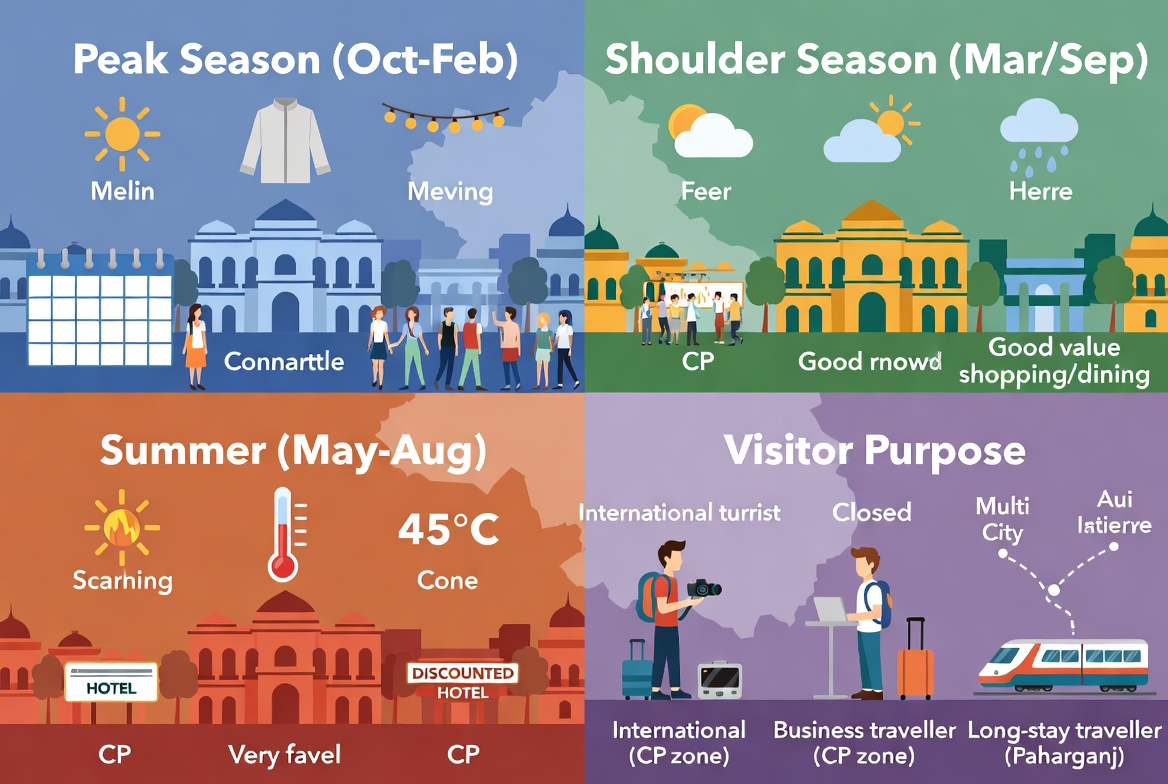
Seasonality reshapes the central Delhi hotel market more than most guides acknowledge. October to February is peak season: pleasant weather, major festivals, and high conference activity drive occupancy above 85% in CP-zone properties. Book at least six weeks ahead for this window, and expect rates 35–60% above the annual average. March and September are shoulder months, good value, reasonable weather.
May to August is a different calculation. Delhi in peak summer (May–June) reaches 44–47°C regularly. Tourist footfall drops, rates fall sharply, and most leisure reasons to be in central Delhi disappear. If your visit during this period is work-driven, you can find genuinely good CP-area properties at steep discounts. The trade-off is the heat, and the fact that several outdoor attractions, including much of the Lutyens zone's appeal, are functionally inaccessible in the afternoon.
For first-time international visitors, the additional variable is visa category. Tourists on e-Visas with limited days benefit most from CP-zone proximity. The compactness of CP means morning sightseeing, afternoon meetings, and evening dining can all happen within three kilometres. For travellers on longer multi-city itineraries using Delhi as a base, Paharganj's station proximity cuts pre-dawn train departure logistics considerably.
Common Mistakes That Cost Visitors Time and Money
Booking a hotel described as 'near Connaught Place' without verifying the actual walking distance is the single most reliable way to be disappointed. In Delhi, 'near CP' on a listing can mean 400 metres (legitimately walkable) or 2.8 kilometres (an auto-rickshaw every time). Check the map pin against the Rajiv Chowk metro station, specifically not against CP's outer circle.
A second mistake is ignoring what's included in the base rate. Delhi hotels at the mid-range tier frequently exclude breakfast, airport transfers, and GST (18% for rooms above ₹7,500 per night, 12% below) from their displayed OTA prices. A ₹4,800 room with 18% GST, a compulsory breakfast charge, and no airport pickup becomes a materially different purchase than it appeared.
Third: trusting review scores without filtering by traveller type. A Paharganj hostel with an 8.4 rating on a major OTA has earned that score primarily from budget backpackers in their 20s. That score tells a 45-year-old business traveller almost nothing about whether the property suits them. Filter reviews by 'business', 'solo', or 'couple' depending on your profile before reading the aggregate.
Finally, many visitors overlook Karol Bagh entirely. It doesn't appear in international travel content as often as CP or Paharganj, but it consistently offers the best mid-range value in central Delhi, with larger rooms, quieter streets, strong local restaurant density, and rates 20–30% below comparable CP properties.
The Variable Nobody Mentions: Your Hotel's Early Arrival Policy
Most central Delhi flights from Europe, the Gulf, and Southeast Asia arrive between 4:00 AM and 7:00 AM. Standard hotel check-in is 14:00. That gap of seven to ten hours is where the real cost of a central Delhi hotel often hides.
Properties in the CP zone and Lutyens tier typically offer guaranteed early check-in at an additional charge of ₹800–2,500, depending on the property tier, or free for loyalty programme members. Paharganj properties frequently offer it informally for a cash arrangement, with wildly variable room quality until a properly cleaned room is available. Karol Bagh mid-range hotels are the most consistent: most will confirm an early check-in at the time of booking for a flat fee, which is the safest option for a traveller arriving at 05:30 after a long-haul flight.
If your arrival is before 08:00, this single policy difference should weigh as heavily in your hotel selection as the star rating. Ask before booking. Get the confirmation in writing. No other practical tip in this guide will save you as much frustration on arrival day.
The Honest Answer on Value in Central Delhi
The mid-range CP zone (₹4,500–₹8,000 per night) is the most competitive hotel segment in Delhi, which means it's also the most inconsistent. Two properties listed at ₹6,000 on the same OTA can differ dramatically in actual condition, one recently refurbished, one last updated in 2016. Star rating does not reliably track this; Delhi's hotel classification system lags physical reality by years.
The most reliable signal in this tier is recency of reviews, not volume. A property with 200 reviews averaging 8.1 from the past six months outperforms one with 2,400 reviews averaging 8.4, where the last 40 reviews drop to 7.6. Filter by 'most recent' before reading average scores, and pay attention to review dates on any negative comments. A noise complaint from 2021 may no longer be relevant; one from last month almost certainly is.
When a Central Delhi Stay Isn’t the Best Fit (And What to Choose Instead)
Not every trip to Delhi is best served by staying in Central Delhi and this is where most guides fall short.
If your priority is proximity to Connaught Place, government offices, or Old Delhi, then the central zones make sense. But for travellers arriving via IGI Airport, attending events in South Delhi, or looking for a quieter, more spacious stay, the trade-offs of Central Delhi become more obvious: congestion, smaller rooms, and limited open space.
This is where properties just outside Central Delhi particularly in areas like Vasant Kunj start to make more practical sense. Located roughly 15–20 minutes from the airport and well-connected to both Aerocity and South Delhi business districts, this zone offers a different kind of stay: less chaotic, more spacious, and often better suited for longer or more relaxed visits.
For example, it sits in Vasant Kunj and offers a full-service luxury environment with larger rooms, landscaped grounds, multiple dining options, and integrated facilities like spa and event spaces something that’s harder to find in dense Central Delhi locations. The key point isn’t that one area is better than another it’s that the right choice depends on how you plan to use your time. If your schedule revolves around Central Delhi landmarks, stay central. If your trip involves the airport, South Delhi, or a more relaxed stay experience, looking slightly beyond Central Delhi can often lead to a better overall outcome.
Frequently Asked Questions
1. How much does a hotel in central Delhi cost per night?
The range is wide. Budget options in Paharganj start around ₹800–1,500 per night for a clean, no-frills room. Mid-range properties near Connaught Place run ₹3,500–8,000. Five-star hotels in the Lutyens–India Gate corridor start at ₹12,000 and rise to ₹30,000+ during peak season (October–February). These figures exclude 12–18% GST, which is added on top and not always shown in OTA base prices.
2. Connaught Place vs Paharganj — which is better for first-time visitors?
For most first-timers, Connaught Place is the better base. It's walkable, safer at night, cleaner, and better metro-connected. Paharganj suits budget-conscious travellers who prioritise low cost and proximity to New Delhi Railway Station over comfort and surroundings. If your budget allows ₹3,000+ per night, stay in or near CP and avoid the trade-offs Paharganj requires.
3. Is it safe to stay in central Delhi as a solo female traveller?
CP-zone and Karol Bagh hotels are generally considered safe for solo female travellers, particularly mid-range and above properties with 24-hour reception and secure access. Paharganj warrants more caution after dark, as street density and poor lighting on some lanes make it less comfortable. In any area, book a hotel with an enclosed entrance and confirmed reception hours rather than a guesthouse with shared access.
4. Do central Delhi hotels include airport transfers?
Most don't include it automatically. Budget and mid-range properties usually offer a paid airport pickup service (₹700–1,500 depending on vehicle type). A faster and often cheaper alternative is the Airport Express Line metro from IGI Airport Terminal 3 to New Delhi station, approximately 20 minutes and ₹60. From New Delhi station, any CP-zone hotel is within two kilometers.
5. What's the practical difference between a 3-star and 4-star hotel in central Delhi?
In Delhi's mid-market, the practical differences are room size (4-star properties typically offer 10–20 sqm more), air conditioning reliability, in-room amenities (kettle, working desk, blackout curtains), and breakfast quality. Service attentiveness also differs noticeably. The price gap is usually ₹2,000–3,500 per night. For a trip of three or more nights, the 4-star tier is often worth the difference purely on sleep quality.
6. Is it worth paying more for a hotel inside Connaught Place's inner circle?
For stays of two nights or fewer, the walkability premium is worth it you'll recover the cost in saved auto-rickshaw fares and time. For stays of five or more nights, CP outer-circle or Karol Bagh properties offer meaningfully better value because the daily savings compound. The inner-circle advantage diminishes rapidly once you've done the immediate area's sightseeing.
7. Does it matter which floor my room is on in a central Delhi hotel?
More than in most cities, yes. Central Delhi street noise, particularly near CP and Paharganj, is significant from 06:00 to 23:00 and can disrupt sleep in lower-floor rooms facing the street. Ask specifically for a room above the 4th floor or facing an interior courtyard when booking, and confirm in writing. This single request resolves the most common negative review complaint across Delhi's mid-range hotel segment.