
4 Star Hotels in Delhi: The Zone-by-Zone Guide That Changes How You Book
Introduction
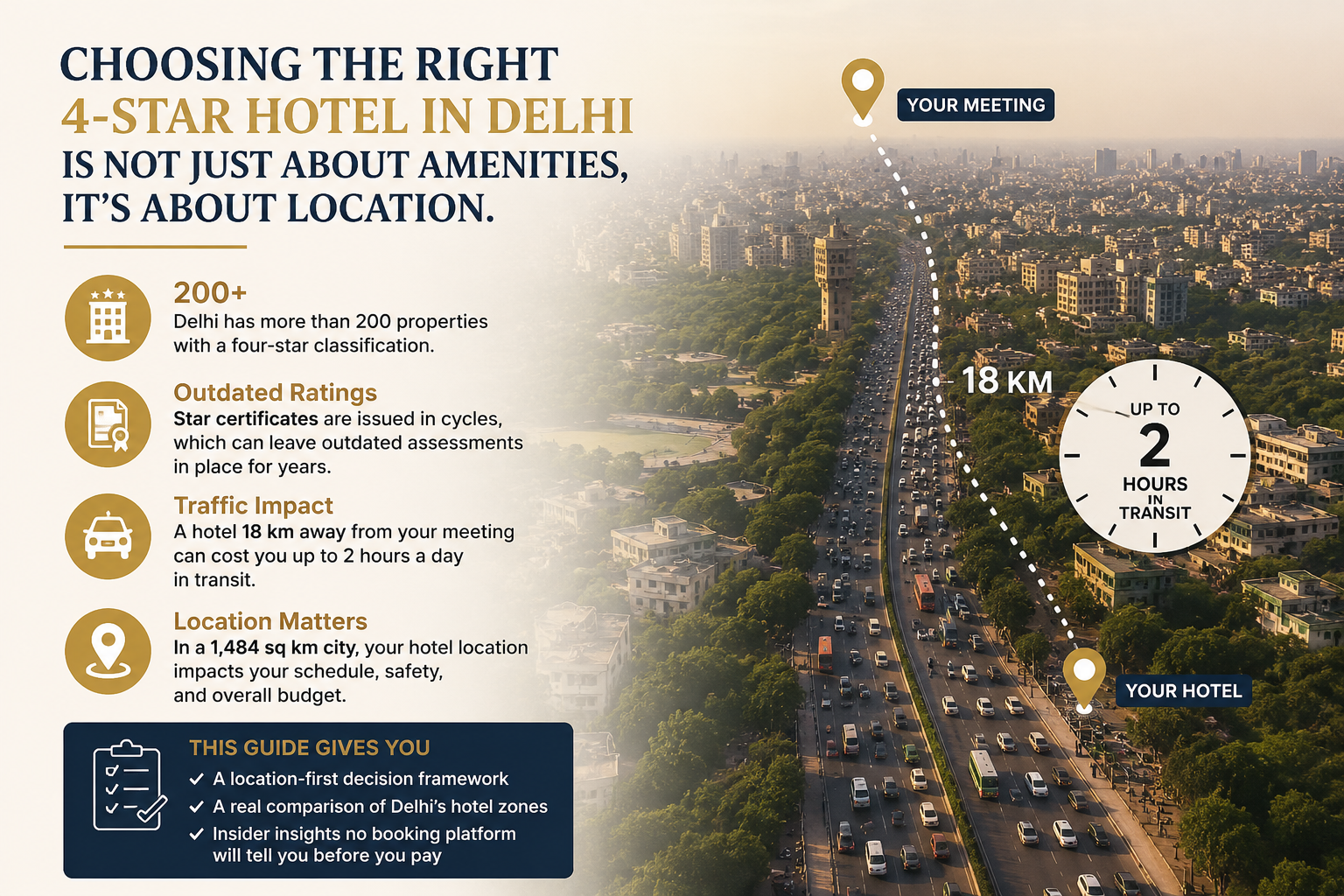
Delhi's hotel market has more than 200 properties carrying a four-star classification, and roughly a third of them are not worth the rating. The Ministry of Tourism issues star certificates on a cycle that can leave outdated assessments in place for years. Meanwhile, the city's traffic patterns mean a hotel 18 km from your meeting can cost you two hours a day in transit. The question of which 4-star hotels in Delhi to book is never just about amenities; it is about where in this 1,484 sq km city you are placing yourself, and what that choice means for your schedule, your safety, and your budget. This guide gives you a location-first decision framework, a real comparison of Delhi's hotel zones, and the specific things no booking platform will tell you before you pay.
What a 4 Star Hotel in Delhi Actually Means (And What It Does Not)
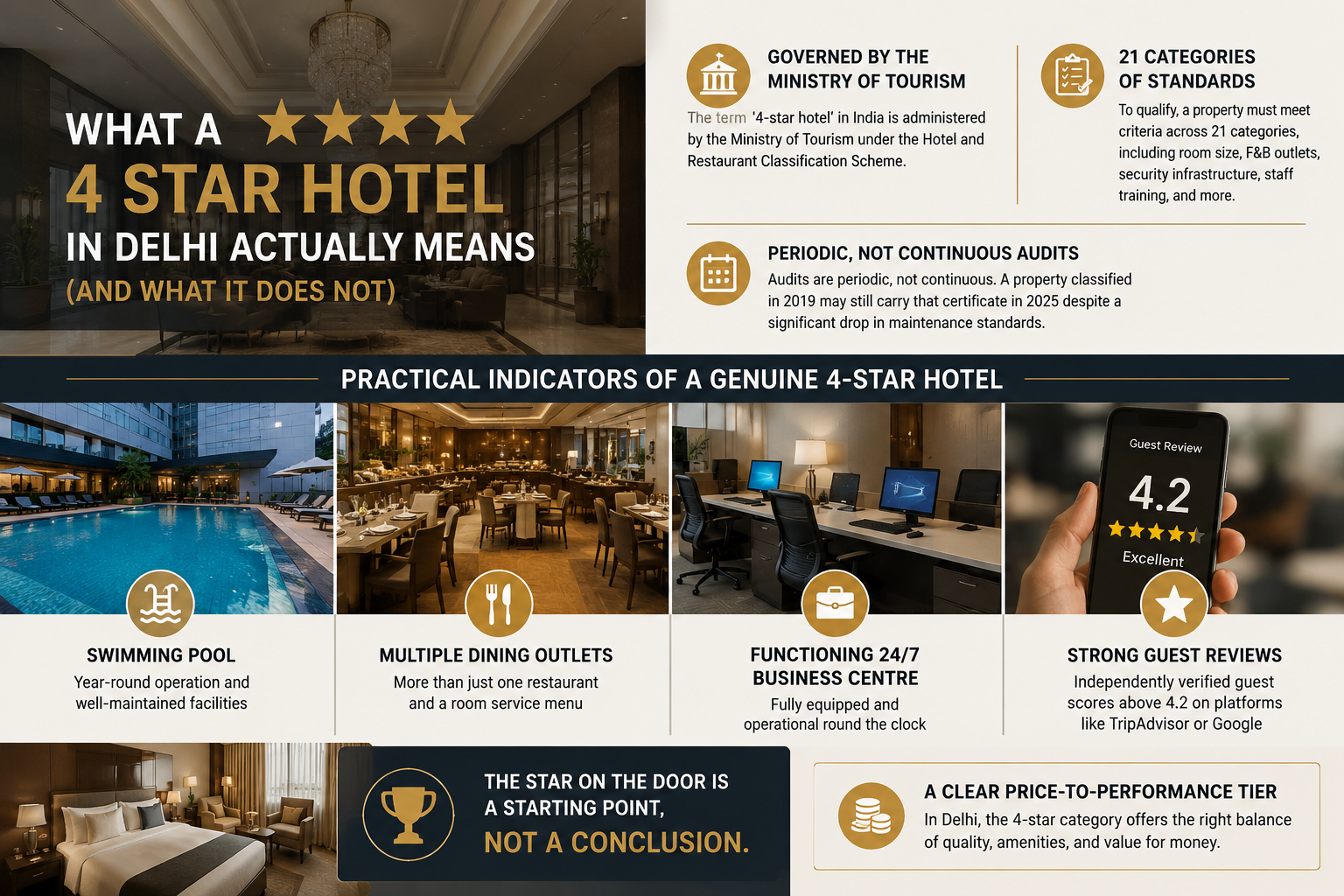
The term '4-star hotel' in India is administered by the Ministry of Tourism under the Hotel and Restaurant Classification Scheme. To qualify, a property must meet criteria across 21 categories, including room size, F&B outlets, security infrastructure, staff training, and more. The classification matters. What most travellers miss is that these audits are periodic, not continuous. A property classified in 2019 may still carry that certificate in 2025 despite a significant drop in maintenance standards.
The practical indicators of a genuine 4-star property as opposed to one that only holds the certificate include: a swimming pool with year-round operation, multiple dining outlets (not just one restaurant and a room service menu), a functioning 24-hour business centre, and independently verified guest scores above 4.2 on platforms like TripAdvisor or Google. The star on the door is a starting point for research, not a conclusion. In the context of Delhi specifically, the 4-star category also represents a clear price-to-performance tier.
The Decision Most Travellers Get Wrong When Choosing a Delhi Hotel
The most common mistake is booking based on hotel name or rating without considering the zone, and discovering only after check-in that the property is 22 km from every important destination on the itinerary.
Here is a real pattern I have seen repeatedly: a corporate traveller books a well-reviewed 4-star hotel in Aerocity because it appears at the top of search results and has an airport proximity badge. Their meetings are in Chanakyapuri, the diplomatic enclave in South Delhi, and at a client office in Nehru Place. What looks like a practical choice becomes a 35 km daily round-trip through some of Delhi's most congested corridors. During peak hours, that is 90 minutes of transit per day across a three-day stay. The hotel saved ₹1,200 per night. The commute costs far more in productivity.
The zone decision in Delhi is not a hotel-quality question. It is a logistics question. Map your itinerary before you open a booking platform. If your anchors are IGI Airport and Gurgaon, Aerocity makes sense. If your anchors are the diplomatic belt, Saket, Lodi Garden, or the Ring Road corridor, South Delhi, specifically the Nelson Mandela Road and Chanakyapuri area, is your zone. Hotels like The Grand New Delhi sit at the intersection of the diplomatic corridor and South Delhi's commercial spine, which is why they attract a disproportionate share of long-stay business guests.
How to Evaluate and Choose Between Delhi's 4 Star Hotel Zones
Use this framework: match your primary destination anchor with the hotel zone, then check commute time to your secondary destinations. Then filter for amenities. Do not start with amenities and work backwards to the location; that is the wrong order. A hotel's facilities mean nothing if you spend three hours a day in a car getting to where you actually need to be.
The Zone-by-Zone Comparison
Use the table below to match your trip profile to the right area. Read the 'Key Tradeoff' column before making any shortlist.
|
Zone / Option |
Best For |
Key Tradeoff |
|
Aerocity (near IGI Airport) |
Transit guests, early flights, short business trips |
Limited sightseeing access; premium pricing due to airport proximity |
|
South Delhi (Chanakyapuri / Saket) |
Diplomats, heritage tourism, upscale leisure stays |
Traffic to the north/central city can add 45–60 mins during peak hours |
|
Connaught Place (Central Delhi) |
First-time visitors, those needing central access |
Congested area; parking is difficult; noisier environment |
|
New Delhi (Lutyens / Diplomatic Zone) |
Business executives, government meetings, embassy visits |
Very limited hotel inventory; higher rates with fewer choices |
|
The Grand New Delhi (Nelson Mandela Rd) |
Full-service business + leisure, groups, long stays |
Not ideal for pure airport transit; best for stays of 2+ nights |
One practical addition: for family stays in Delhi, the South Delhi zone consistently outperforms Aerocity. The proximity to Qutub Minar, Lodi Garden, and the upscale Saket malls, combined with the quieter, greener environment of properties like The Grand, makes it a more sustainable choice for trips of more than two nights.
What Changes Depending on Your Travel Context
The right 4-star hotel in Delhi changes significantly based on four variables: trip purpose, group size, length of stay, and budget flexibility [source].
Trip purpose: Business travellers with embassy or diplomatic meetings should prioritize Chanakyapuri adjacency above all else. Leisure tourists visiting heritage sites (Qutub Minar, Humayun's Tomb, Lodi Garden) should anchor in South Delhi. MICE groups need properties with integrated conference infrastructure and banquet capacity, a subset of 4 star hotels that is smaller than most planners assume.
Length of stay: For a single overnight transit, Aerocity's convenience justifies the premium. For stays of three or more nights, the lack of walkable leisure options around Aerocity becomes a real limitation. South Delhi properties offer more in-property variety, multiple restaurants, pool access, and larger grounds that sustain a longer stay without cabin fever.
Group size: Larger groups (10+ rooms) should shortlist only properties with dedicated group coordinators and flexible dining arrangements. The Grand New Delhi's banquet capacity (up to 3,000 covers) and multi-outlet F&B make it one of the few 4-star properties in Delhi genuinely equipped for large group logistics.
Budget sensitivity: Season matters in Delhi. Peak conference season (October–March) sees 4-star rates rise 20–40% across the city. If you have flexibility, May–June offers the steepest discounts up to 35% at properties like The Grand at the cost of summer heat that is manageable with a pool and air-conditioned spaces.
Alt text: Delhi hotel location comparison infographic showing travel time between Aerocity, Chanakyapuri, Nehru Place, and South Delhi for business travelers choosing the right 4 star hotel in Delhi near IGI Airport and key business districts
Common Mistakes When Booking 4 Star Hotels in Delhi
Beyond the zone error described earlier, these are the specific mistakes with documented consequences [source]:
- Trusting the star rating without checking recency. Ask the hotel directly when their last Ministry of Tourism classification audit was conducted. Properties audited more than three years ago should be treated as unverified until guest reviews confirm current standards.
- Booking without checking the F&B hours. Delhi's 4-star segment varies widely in in-room dining cut-off times and restaurant operating hours. For late arrivals from international flights, a hotel that stops room service at midnight is a practical problem. The Grand New Delhi operates 24-hour in-room dining not standard across the category.
- Ignoring Wi-Fi infrastructure for business stays. Hotel Wi-Fi in India varies dramatically between properties. Business travellers should specifically ask about dedicated business-floor bandwidth or conference room connectivity before booking. A hotel listing 'Wi-Fi available' may be referring to lobby access only.
- Overlooking airport transfer logistics. '4-star hotels near Delhi Airport' is a valid search, but proximity is not the same as connectivity. Some South Delhi properties, including The Grand, offer airport transfers that can be pre-booked, effectively closing the distance gap for guests who value the zone advantages of South Delhi but need reliable airport access.
Why Delhi Hotel Location Is a First-Principles Decision, Not a Preference
Every major travel platform ranks hotels by price, rating, and availability. None of them models the actual cost of a misaligned hotel location, and in Delhi, that cost is measurable [source].
Delhi's road network is radial, not grid-based. The Ring Road and outer ring connect zones, but peak-hour congestion on corridors like NH-48 (Airport to South Delhi), the ITO stretch, and Mathura Road can make a 12 km journey take 55 minutes. This is not a complaint about Delhi's infrastructure; it is a structural fact that experienced Delhi travellers build into their hotel decisions from the start.
The first-principles approach: before opening any booking platform, draw a map with three pins: your most frequent destination, your second most frequent destination, and the airport. The hotel that sits closest to the triangle formed by those three points is your optimal zone. Apply the standard quality filters (rating, amenities, review recency) only after the zone is established.
The Grand New Delhi sits on Nelson Mandela Road, the arterial road connecting the Diplomatic Enclave, the Ring Road, and the airport corridor. For guests whose triangle includes IGI Airport, Chanakyapuri, and either Gurgaon or central Delhi, it occupies one of the most logistically efficient positions available in the 4-star category. This is not a marketing position; it is geography. The value of that position compounds over a multi-night stay in a way that a ₹800-per-night saving at an Aerocity property rarely matches.
The Honest Answer About 4 Star Hotels in Delhi
There is a tradeoff no hotel review site acknowledges directly: the best-located hotels in Delhi are not always the best-reviewed, and the best-reviewed hotels are not always the best-located. These rankings diverge because review scores heavily weight in-room experience, bed comfort, bathroom quality, F&B variety, while location impact is diffuse and rarely attributed directly to the hotel in post-stay feedback. A traveller who lost 90 minutes per day in transit is likely to rate the hotel's Wi-Fi down, not write 'poor location choice.'
My clear position: for any stay in Delhi exceeding two nights, location should be weighted at least as heavily as amenity quality in your decision. A hotel with a 4.1 rating in the right zone will deliver more total value than a 4.6-rated property that doubles your daily commute. Prioritize the zone first, then use review scores to choose within that zone. This is the decision sequence that experienced Delhi travellers use, and the one that booking platforms are structurally unable to teach you.
Ready to Book Your Stay at The Grand New Delhi?
You have done the research. The Grand New Delhi sits at the intersection of South Delhi's diplomatic corridor and the city's primary road network with five dining outlets, conference infrastructure for groups of any size, and an outdoor pool on 9 acres of grounds. Whether you are booking for a business trip, a family visit, or a long stay with multiple Delhi itineraries, the location does the heavy lifting. Visit thegrandnewdelhi.com to check current availability, explore room types, and speak with our reservations team about group rates, airport transfers, and conference packages tailored to your trip.
Frequently Asked Questions
1. How much does a 4-star hotel in Delhi cost per night?
Rates typically range from ₹5,000 to ₹12,000 per night, depending on location, season, and room type. Aerocity and Lutyens' Delhi command a premium.
2. 4-star hotels in Aerocity Delhi vs South Delhi — which is better?
It depends entirely on your itinerary. Aerocity is optimized for transit: you are 5 minutes from Terminal 3 and 15 minutes from the domestic terminal. South Delhi is better if you have meetings in the diplomatic enclave, plan to visit Qutub Minar, or need a quieter environment for a longer stay.
3. Is it safe to book a 4-star hotel in Delhi for solo female travel?
Reputable 4-star properties in South Delhi and Aerocity maintain 24-hour security, CCTV, and trained staff safety standards that meet international hospitality benchmarks. The Grand New Delhi, for example, has round-the-clock concierge support and secure in-house dining until late.
4. Are all 4-star hotels in Delhi of the same quality?
They are not, and this is the most common mistake travellers make. India's hotel star ratings are assigned by the Ministry of Tourism, but the audit cycle is infrequent. A property can carry a four-star certificate while operating at three-star standards.
5. What is the difference between a 4-star and a 5-star hotel in Delhi in practical terms?
In Delhi specifically, the gap is smaller than the price difference suggests. A genuine 4-star hotel will have consistent linen quality, trained F&B staff, reliable Wi-Fi, and a business centre. The additional cost of a 5 star in Delhi typically buys you a larger room footprint (40–50 sqm vs 28–35 sqm), an in-room butler option, and a flagship restaurant with a celebrity chef. For most business travellers, the 4 star tier delivers 85–90% of the experience at 60–70% of the cost.
6. Are 4 star hotels in Delhi worth the price over 3 star options?
For stays of two or more nights, typically yes. The visible difference shows up in F&B quality (in-house dining is safer and more consistent), housekeeping frequency, and bathroom standards. For a one-night transit stay, a well-reviewed 3-star near the airport may be more practical. For extended business trips, family travel, or when your stay is part of a client-facing itinerary, the consistency of a 4-star property like The Grand protects your schedule from the small failures, such as slow check-in, Wi-Fi dropout, and noise that cost you more in disruption than the price difference.
7. Does it matter which part of Delhi my hotel is in for VISA or embassy appointments?
Yes, significantly. Most embassies are concentrated in the Chanakyapuri area of South Delhi the US, UK, German, French, and Australian missions are all within 3 km of each other. A hotel in South Delhi cuts your pre-appointment commute to under 15 minutes.
8. What makes The Grand New Delhi different from other 4-star hotels in Delhi?
The Grand sits on 9 acres on Nelson Mandela Road in South Delhi, an unusual amount of green space for a city hotel. It operates five restaurants and a bar under one roof, which matters for groups and multi-day stays when guests want variety without leaving the property.