
The Best Pre-Wedding Locations in Delhi, And the Private Estate Most Couples Don't Know About
Delhi has no shortage of beautiful pre-wedding shoot locations. The problem is that 90% of couples end up at the same five places as everyone else. Lodhi Garden before 7 AM, Hauz Khas with a permit, Humayun's Tomb with 200 other tourists in the background. The images are beautiful, but they look like everyone else's images. This guide covers every major pre-wedding location in Delhi, honestly, what each costs, what the crowds are actually like, what kind of photographer you need for each setting, and where to shoot when you want images that match a five-star wedding rather than a public park. By the end, you'll know exactly which location fits your aesthetic, your budget, and your timeline.
What a Pre-Wedding Shoot Location Actually Needs to Deliver
Most couples pick a pre-wedding shoot location the way they pick a holiday destination based on how it photographs in someone else's images. The result is a shoot that looks like every other shoot taken at that spot, which defeats the purpose. A location's job is not to be famous. Its job is to do four specific things: provide a background that matches your wedding's visual register, offer enough light flexibility for your photographer to work across different setups, allow sufficient privacy for candid moments, and not require so much logistical effort that the day becomes stressful before it begins.
Lodhi Garden, for instance, photographs extraordinarily well in the hands of a skilled photographer. But it is a public park. The ASI does not block off sections for private shoots. On a Sunday morning in October, peak wedding season, there will be walkers, cyclists, families, and other shoot teams within frame distance. Your photographer can manage this with timing and positioning, but it requires experience and often multiple location changes within the same space.
The variable most couples overlook is the visual register of whether the shoot location's aesthetic matches the wedding venue. A couple shooting at Hauz Khas village (bohemian, rustic, urban) and marrying in a five-star ballroom in Vasant Kunj is creating a visual narrative that doesn't connect. Pre-wedding images appear in wedding montages, invitation cards, and wedding hashtag feeds alongside venue photographs. When the locations match in tone, the overall wedding story coheres. When they don't, both sets of images look slightly out of place.
The Decision Most Couples Get Wrong: Public vs. Private Shoot Locations
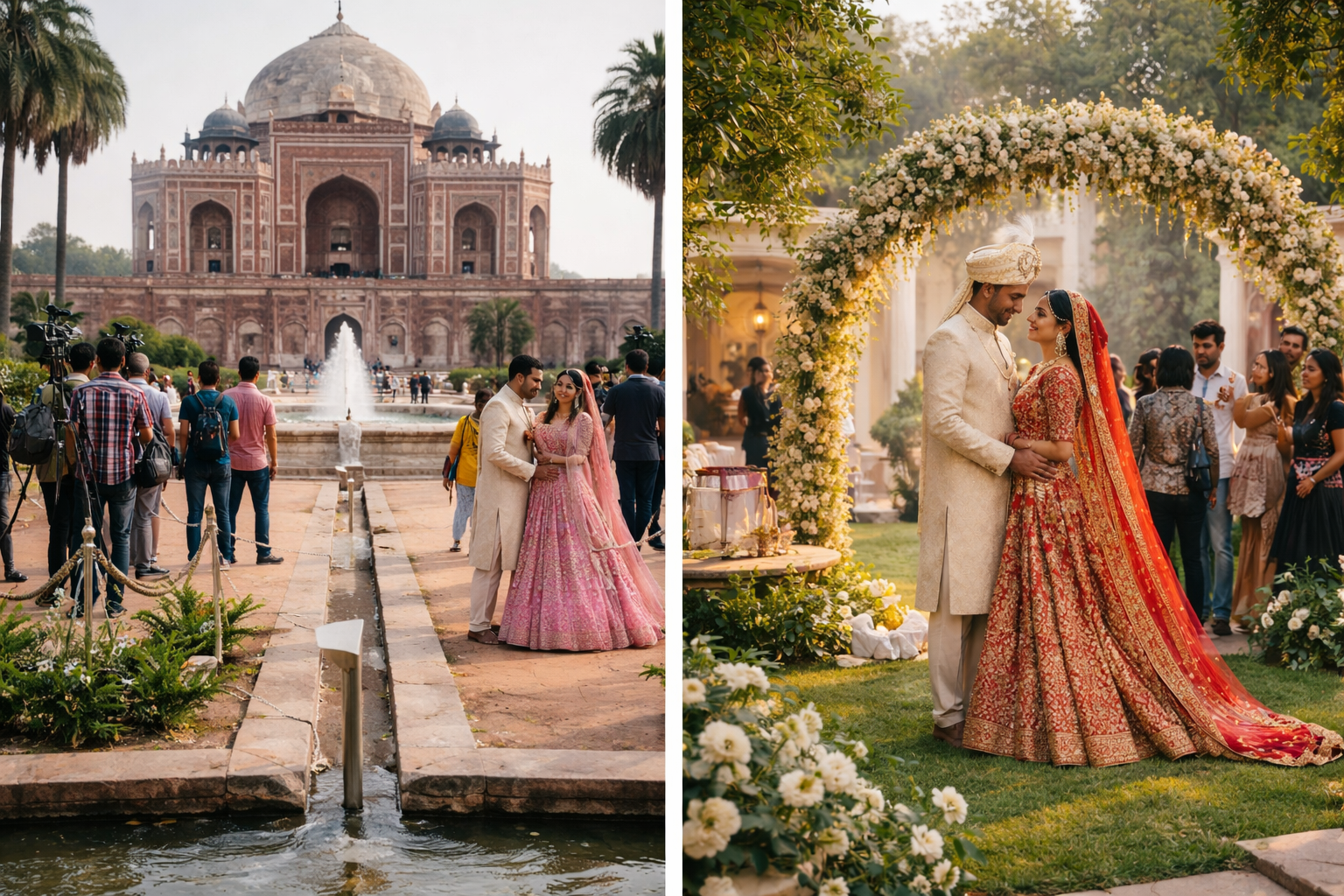
A photographer in Delhi recently described a common scenario: a couple books Humayun's Tomb for their pre-wedding shoot, pays the ASI permit fee (currently ₹10,000 onwards), arrives at 7 AM, and finds that the permit doesn't guarantee exclusivity — it only guarantees access. Three other shoot teams are already there. The fountain area, the most photographed spot, has a rope barrier and a security guard. The couple gets their images, but the 'private, romantic' moment they imagined was actually choreographed around 30 metres of crowd management.
This is not a reason to avoid public locations. It is a reason to understand what you are actually buying when you choose one. Public heritage sites, such as the Qutub Minar complex, Lodhi Garden, India Gate, and Mehrauli Archaeological Park, offer unmatched architectural grandeur and photographic depth. They are the correct choice when your wedding has a heritage or classical aesthetic, and your photographer is experienced enough to work around the logistical constraints. Private locations, luxury hotel estates, private farmhouses, and resort grounds offer something different: control. You can shoot at 11 AM when the garden light is right, not just at 7 AM before the crowds arrive. You can take thirty minutes on a single frame. You can bring a styling team without coordinating their access through security. The images at a private location tend to have more variety of composition because the photographer is not working around other people's sightlines.
The practical test: if your pre-wedding shoot day has a shot list of more than 15–20 setups, a public heritage site will run you out of time and patience. If your list is focused 8–12 setups in a single estate with multiple distinct micro-environments, a private location like The Grand New Delhi's grounds delivers more usable images per hour of shooting time.
How to Choose the Right Pre-Wedding Shoot Location in Delhi
The correct framework is not a list of locations. It is a set of four questions that filter your options before you look at a single photograph:
- What is the visual register of your wedding? Classical and grand → heritage sites. Luxurious and contemporary → five-star estate. Bohemian and artistic → Hauz Khas, Lodhi Art District.
- How much logistical complexity can you absorb? Low tolerance → private estate. High tolerance + experienced photographer → public monument.
- How many setups do you want? Under 10 focused setups → any good location works. 15+ setups → private estate gives more flexibility. Public sites require location changes to achieve variety.
- What is your styling team's size? 2–3 people → anywhere. Makeup artist + stylist + assistant + multiple outfit changes → private location with changing room facilities.
Run those four questions before looking at images. Then use the table below to match your answers to the right category:
|
Location / Option |
Best For |
Key Tradeoff |
|
Lodhi Garden / Hauz Khas |
Heritage-garden aesthetic; couples who want greenery + ruins |
Public space — crowds, no crowd control, permits required on weekends |
|
Qutub Minar / Humayun's Tomb |
Grand Mughal architecture; regal editorial look |
Strict ASI photography rules; permit fees ₹10,000+; tourist foot traffic |
|
India Gate / Kartavya Path |
Iconic, patriotic; dramatic evening lighting |
No permit for professional shoots; security restrictions; no private access |
|
The Grand New Delhi (hotel estate) |
Couples who want luxury grounds, privacy, and styling support under one roof |
Requires hotel booking or shoot package — not a free public location |
|
Neemrana / Rajasthan forts |
Royal destination-shoot aesthetic; fairytale architecture |
2–3 hr drive from Delhi; full-day commitment; logistics-heavy |
How the Right Location Changes Depending on Your Wedding Aesthetic
Heritage and Mughal aesthetic
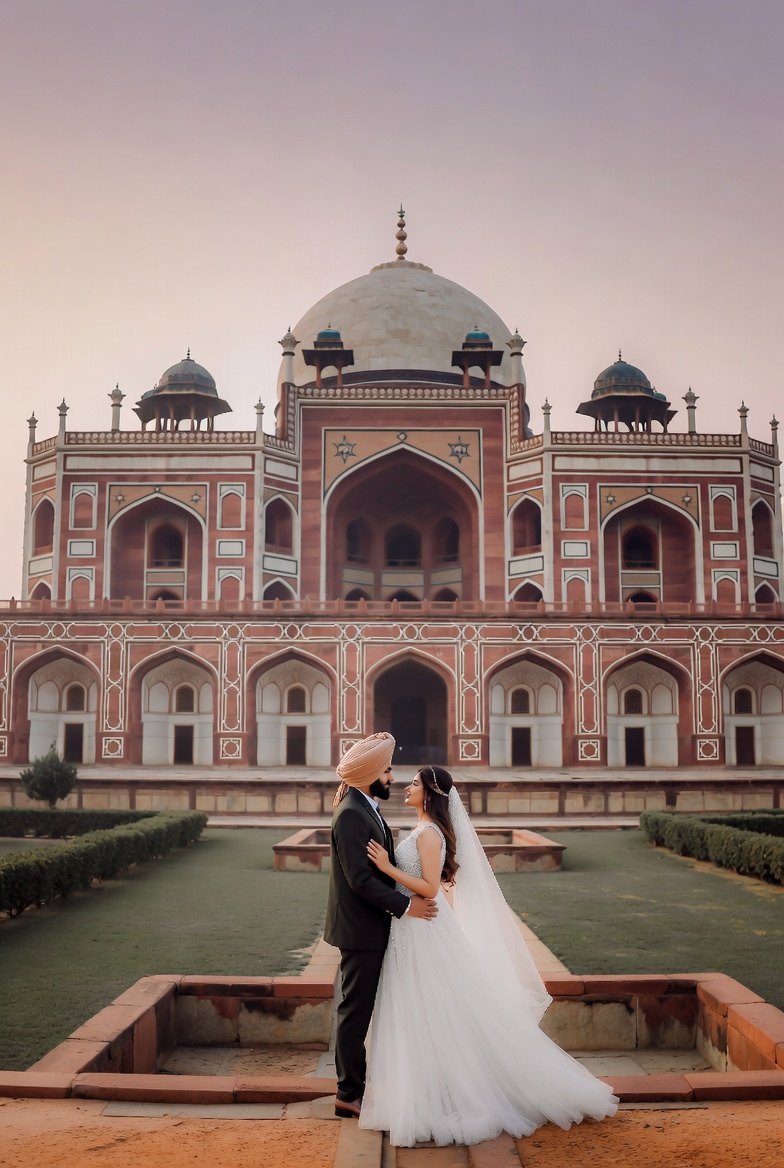
If your wedding leans towards classical heavy embroidery, Mughal-inspired décor, and a banquet hall with arched details, then Humayun's Tomb, Safdarjung Tomb, or Mehrauli Archaeological Park provide visual continuity. These locations work best with ethnic outfits in jewel tones. The ASI permit cost and crowd management are the tradeoffs you accept. Budget ₹8,000–₹15,000 in permit fees and arrive no later than 6:30 AM.
Contemporary luxury aesthetic
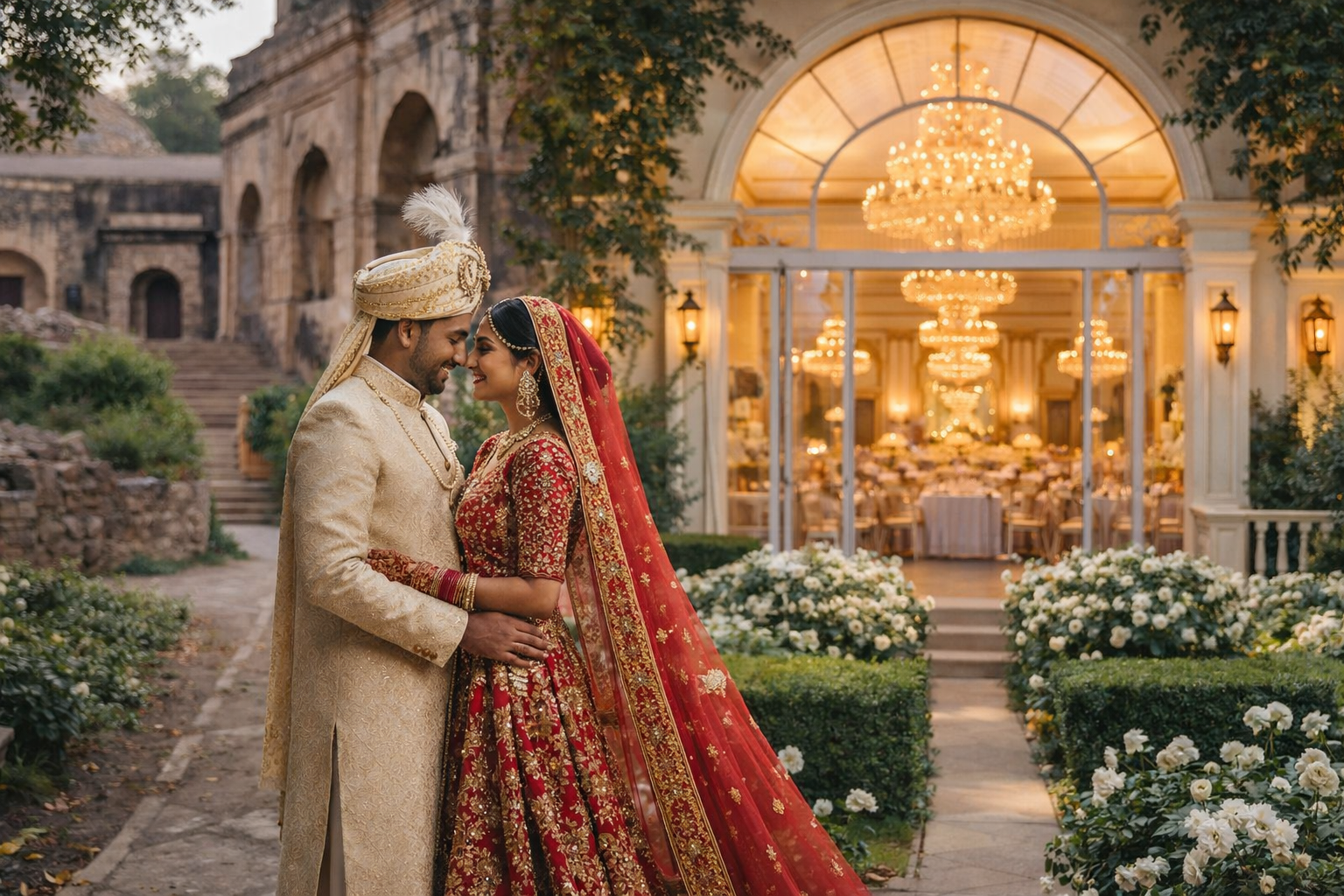
For couples whose wedding is in a five-star ballroom in South Delhi at The Grand New Delhi, for example — the correct pre-wedding location is one that matches that register. Garden of Five Senses is a curated option. The Grand's private estate is the complete option: manicured lawns, water features, architectural backdrop, and indoor-to-outdoor transitions that mirror the wedding venue itself. Couples shooting here rarely feel they are compromising on scale or beauty.
Urban and editorial aesthetic
Couples who want images that feel like a fashion editorial, clean lines, graphic backgrounds, modern styling should look at Connaught Place on a Sunday morning (the only time it is quiet enough for professional shoots), the Lodhi Art District, or select rooftop locations in South Delhi. These work with contemporary outfits: structured gowns, suits, and minimalist lehengas. Timing is critical; arrive before 8 AM on weekdays or face unworkable crowds.
Common Mistakes Couples Make When Booking a Pre-Wedding Shoot Location in Delhi
Booking the location before booking the photographer
Your photographer's familiarity with a location matters more than the location itself. A photographer who knows Lodhi Garden's sightlines, the morning light angle at Hauz Khas, and the security rules at Sunder Nursery will create better images than one who is visiting the location for the first time with you. Book your photographer first, discuss locations together, and let their practical knowledge of Delhi's spots inform your final choice.
Underestimating permit timelines for ASI monuments
The Archaeological Survey of India processes photography permits for professional shoots at heritage monuments, Qutub Minar, Humayun's Tomb, Red Fort, and Safdarjung Tomb, through their regional office. Permit applications require advance notice of 7–15 working days, and peak wedding season (October–December, February–March) creates processing delays. Couples who assume they can arrange a permit 48 hours before the shoot date frequently find the location unavailable. Private estates like hotel grounds require no ASI permit — only a booking confirmation with the hotel's events team.
Choosing a location for its Instagram reputation rather than its light
Yamuna Ghat is extraordinary but only at sunrise, specifically between 6:15 and 7:00 AM during winter months when the seagulls and morning mist create that iconic frame. At 9 AM, it is a concrete riverbank. The Garden of Five Senses shoots beautifully in October and November; by March, the seasonal blooms are gone. Agrasen ki Baoli is best in early morning before 8 AM; by 10 AM, it is a tourist site. Every location in Delhi has a 'window', the time of day and season when it performs at its best. Choosing a location without knowing its window is how couples end up with flat, crowded images at places that look stunning in other people's photographs
The Grand New Delhi: Delhi's Private Estate Pre-Wedding Shoot Location
Ten acres in the middle of Vasant Kunj. Manicured lawns that stretch across 24,000 square feet. A raised terrace garden with panoramic views of the hotel's water features. A pool terrace with clean architecture and reflection pools. A lobby with a soaring ceiling, natural skylights, and black marble floors that photograph like an editorial set. This is The Grand New Delhi and it is the pre-wedding shoot location in South Delhi that most photographers know about and most couples don't.
Unlike every other location on this list, The Grand offers what no public monument can: total creative control. Your shoot team arrives at the time that works for your shot list, not the time dictated by a park's opening hour or a security guard's patience. There are no other photographers within frame. There are no tourist groups walking through your background. The hotel's concierge team can arrange changing facilities, makeup rooms, and catering so your shoot day functions as a production, not a negotiation.
Grand Greens, the hotel's signature outdoor venue spanning 24,000 square feet of lush garden, gives photographers multiple distinct natural backdrops within walking distance of each other: open lawn for wide editorial frames, tree-canopied paths for dappled natural light, and raised landscaped sections for elevation shots that most Delhi locations cannot offer. The Cascade Top Garden a raised venue with views across the hotel's water bodies, provides the kind of dramatic, uncluttered backdrop that requires either a Rajasthan trip or a well-designed estate.
The Honest Answer: Location Isn't the Biggest Variable
Here is what this article has not said directly: the location is not the most important variable in a pre-wedding shoot. The photographer is. A technically skilled photographer who understands light can make Lodhi Garden look like a private estate and make a private estate look like a fashion editorial. A mediocre photographer at Humayun's Tomb will produce images that look like tourist photographs with expensive outfits.
The tradeoff this matters for: if your budget is ₹80,000 and you're choosing between spending it on a better photographer at a free location, or a moderate photographer at an expensive paid location, take the better photographer every time. The location provides the raw material. The photographer produces the image.
That said, a great photographer at a great location, specifically one with multiple distinct environments, controllable conditions, and the kind of architectural scale that The Grand New Delhi's estate provides, will produce the best images of your life. The two variables compound. The location ceiling only matters when the photographer can reach it.
Frequently Asked Questions About Hotels in Chattarpur
1. How much does a pre-wedding shoot location cost in Delhi?
Public parks like Lodhi Garden have no location fee, but professional photography permits at ASI heritage sites, Qutub Minar, Humayun's Tomb, and Red Fort, run ₹5,000–₹15,000 and require advance application. Private locations like luxury hotel estates charge a shoot package fee that typically includes venue access, changing facilities, and a dedicated point of contact. The total shoot day cost, including photographer and styling, ranges from ₹40,000 to ₹2,00,000+, depending on your choices.
2. Lodhi Garden vs The Grand New Delhi estate, which is better for a pre-wedding shoot?
They serve different couples. Lodhi Garden is the correct choice if you want heritage greenery, a classical Mughal-garden aesthetic, and are comfortable with early-morning logistics and occasional crowd management. The Grand New Delhi estate is the correct choice if you want privacy, multiple distinct backdrops in one location, no permit paperwork, and images that match a five-star wedding aesthetic. The question is not which is better — it is which fits your wedding's visual register.
3. Do I need a permit for a pre-wedding shoot at The Grand New Delhi?
No ASI permit is required for a pre-wedding shoot on The Grand New Delhi's private estate. The hotel's grounds, Grand Greens, Cascade Top Garden, pool terrace, and architectural spaces are on private property. You arrange the shoot through the hotel's events team, who confirm access, facilities, and timing. This is one of the primary advantages of a private estate over an ASI monument: zero permit bureaucracy, flexible timing, and no risk of a last-minute access refusal.
4. Is Hauz Khas village good for a pre-wedding shoot in Delhi?
Hauz Khas Village works well for couples who want a bohemian, urban-rustic aesthetic, graffiti walls, the fort ruins, the lake view, and the cafés. The challenge is that it is now heavily photographed, and several cafés charge location fees for professional shoots. It is not a controlled environment. The shoot quality depends heavily on the time of day (best: late afternoon on a weekday), your photographer's knowledge of the area, and your outfit choices. It suits contemporary and relaxed aesthetics more than traditional or formal ones.
5. What time of year is best for a pre-wedding shoot in South Delhi?
October through February is the optimal window. Temperatures are manageable (15–25°C), the light is soft and golden during the blue hour, and the monsoon's greenery is still present through November. March brings pleasant weather, but the Garden of Five Senses' seasonal blooms thin out. April–June is harsh midday temperatures exceeding 40°C, which makes outdoor shoots physically uncomfortable and limits shooting windows to 30-minute bursts around sunrise. Winter mornings (December–January) are cold but produce the clearest, most cinematic light of the year.
6. What is the cost of a pre-wedding shoot at The Grand New Delhi?
The Grand New Delhi offers pre-wedding shoot packages through the hotel's events and banquet team. Packages typically include estate access, changing facilities with mirrors and lighting, concierge coordination, and optional add-ons like Oasis Spa beauty services or catering for the shoot team. Pricing varies based on the areas included and the duration — contact the events team directly at +91 11 4766 1200 or email the concierge for a current package quote.
7. Does it matter if I choose a location that matches my wedding venue?
It matters for the cohesion of your overall wedding visual story but not for the quality of individual images. If your pre-wedding images will only appear on your personal devices, the venue match is irrelevant. If they will appear in your wedding album, on your invitation cards, in the wedding highlight video, or in a social media feature, visual continuity between pre-wedding and wedding location creates a narrative that makes both sets of images stronger. Couples marrying at The Grand New Delhi who also shoot there find that their album tells a single, continuous story rather than two separate ones.
8. Can we shoot indoors at The Grand New
Delhi for a pre-wedding session?
The Grand's interior, specifically the lobby with its natural skylights, black
marble floors, and soaring ceiling offers
strong architectural indoor framing. The Cascades lounge, which looks out onto
the landscaped gardens, provides a
transitional indoor-outdoor setup that works especially well for evening and
late-afternoon light. Indoor shoots at the
estate remove weather and crowd variables entirely, making them reliable
regardless of season. Contact the events team
to confirm which interior spaces are available for the shoot date.